Zoho Books vs Tally Prime: Which Accounting Software Is Right for Your Indian SMB?
Tally Prime has dominated Indian SMB accounting for decades. Zoho Books is cloud-native, integrated, and built for automation. Here is how to decide which fits your business in 2026.
Tally Prime is the accounting standard for tens of thousands of Indian businesses. It works offline, handles GST, and does what it says. But a growing number of SMBs are asking a harder question: does Tally still fit where we are going, not just where we have been?
Zoho Books is cloud-native, deeply integrated with eCommerce platforms, and built for teams that need access from anywhere. Comparing these two platforms honestly means looking at more than feature lists. It means asking which one reduces the friction in your actual workflow, which one your accounts team will actually use, and which one grows with you as GST compliance rules tighten and your sales channels multiply.
This guide breaks down both platforms across the dimensions that matter most to Indian SMBs in 2026: GST compliance, pricing, integrations, reporting, and the practical cost of switching.
What Is Tally Prime?
Tally Prime is the current version of TallyERP 9, the accounting software that has been a fixture in Indian business for over three decades. It is a desktop-first application with optional cloud hosting through Tally's own server or third-party configurations. Tally Prime covers core accounting (ledgers, vouchers, trial balance), inventory management through godowns and stock groups, payroll, and GST filing through its connected portal. Most Tally installations in India run on a perpetual license model with an annual Tally Software Services (TSS) subscription for cloud access, GST updates, and support.
Tally's strength is familiarity. Accountants trained on Tally can navigate it quickly, and the voucher-based data entry model is well-understood across the profession. The software runs reliably on low-specification hardware and handles large volumes of transactions without performance issues.
What Is Zoho Books?
Zoho Books is a cloud accounting platform built by Zoho Corporation, an Indian software company with over 100 million users globally. It covers invoicing, expense tracking, bank reconciliation, GST returns, e-invoicing, payroll (through Zoho Payroll), and multi-currency transactions. Because it is part of the Zoho ecosystem, it connects natively to Zoho CRM, Zoho Inventory, Zoho Analytics, and over 50 other Zoho applications. It also integrates directly with Shopify, Amazon, WooCommerce, Stripe, Razorpay, and other platforms through native connectors and Zoho Flow automation.
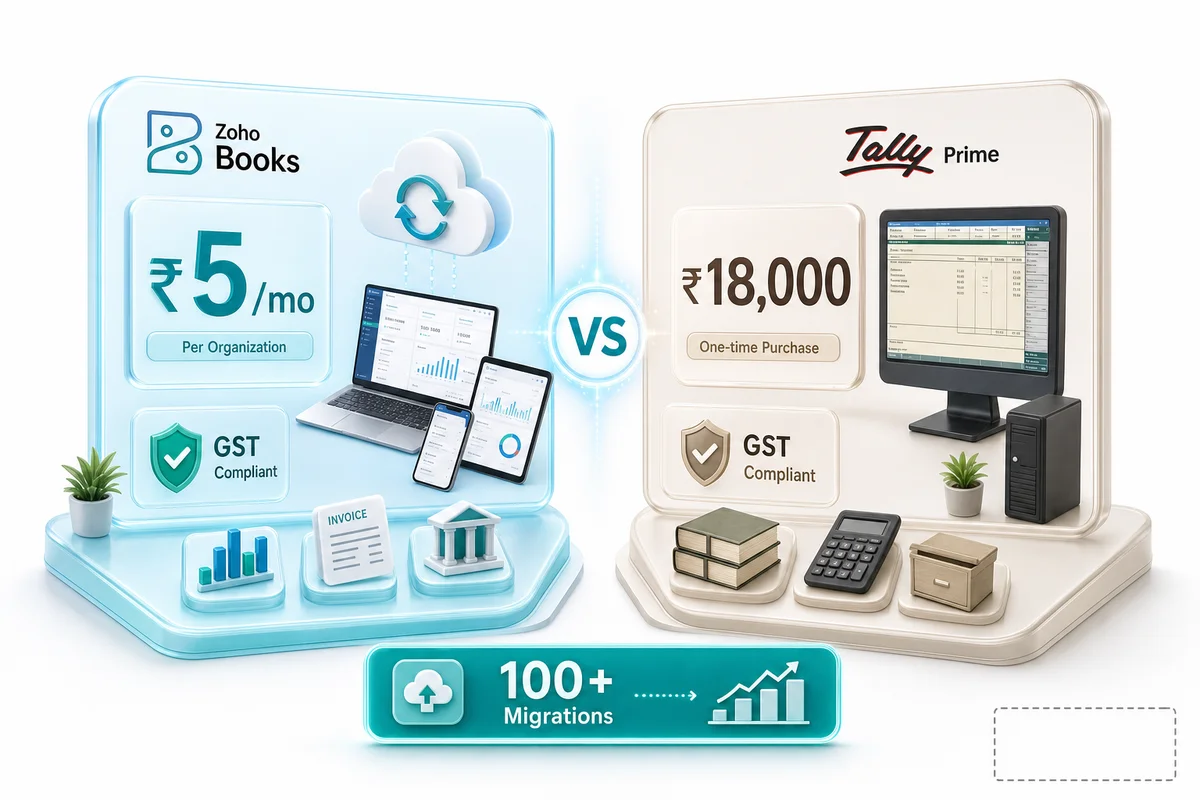
Zoho Books is subscription-based, starting at $15 per month, and requires no local installation. Every user with an internet connection can access the same live data simultaneously, and the mobile app supports invoice creation, expense capture, and approval workflows from any device.
Zoho Books vs Tally Prime: Feature Comparison
| Feature | Zoho Books | Tally Prime |
|---|---|---|
| Deployment | Cloud-native | Desktop (cloud optional via TSS) |
| GST e-invoicing | Built-in IRP integration | Via TSS add-on |
| GSTR filing | Automated GSTR-1, 3B, 2A reconciliation | Manual export to GST portal or via add-on |
| E-way bills | Built-in module | Built-in module |
| Multi-currency | Yes, with auto exchange rates | Yes |
| Mobile app | Full-featured iOS and Android | Companion app (limited) |
| Inventory | Basic; advanced via Zoho Inventory | Built-in godown/stock group model |
| eCommerce integrations | Shopify, Amazon, WooCommerce, eBay, Etsy | Limited native integrations |
| Bank feeds | Automated (300+ banks) | Manual or via add-on |
| Multi-user access | Role-based, simultaneous | License-limited concurrent users |
| Pricing model | Subscription ($15/month and up) | Perpetual license plus TSS |
| Offline access | Browser cache only | Full offline |
| Zoho ecosystem | Full integration | No |
| API access | Yes (REST API) | Limited |
| Audit trail | Automatic, tamper-evident | Yes |
| Custom reports | Yes (Zoho Analytics integration) | Yes (TDL customisation) |
Where Tally Prime Falls Short for Growing Businesses
Cloud access is an afterthought, not a foundation
Tally Prime was designed as a desktop application. Cloud access through TallyPrime via browser requires the TSS subscription and a Tally server running on a machine within your network, or a third-party hosted Tally setup. This creates infrastructure overhead: someone has to manage that server, handle backups, and coordinate remote access permissions. Zoho Books, by contrast, is fully cloud-native. Every user logs in through a browser or mobile app, with no server to manage and no VPN required.
For businesses with remote teams, travelling sales staff, or accountants working from multiple locations, this distinction matters every day.
eCommerce integrations require workarounds
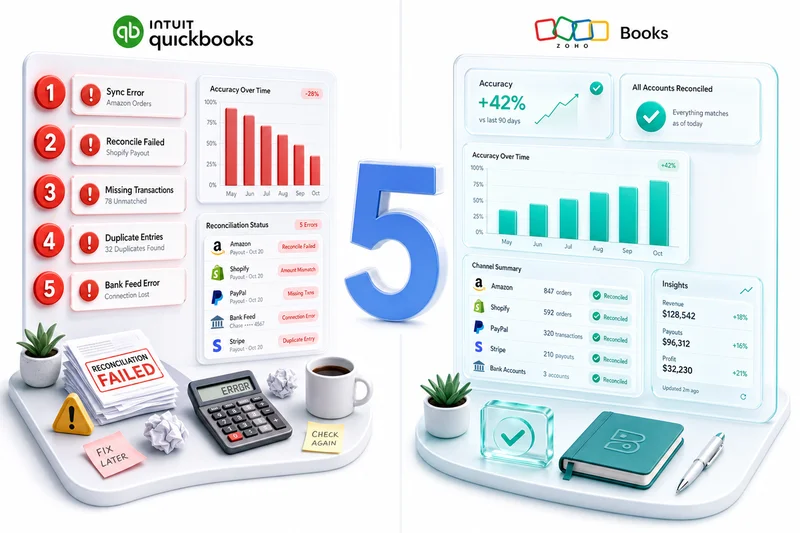
If your business sells on Shopify, Amazon, or WooCommerce, Tally Prime's integration story depends on third-party middleware that pushes order and payment data into Tally through custom imports. These integrations require ongoing maintenance, break when platforms update their APIs, and rarely handle fee reconciliation or multi-channel inventory correctly.
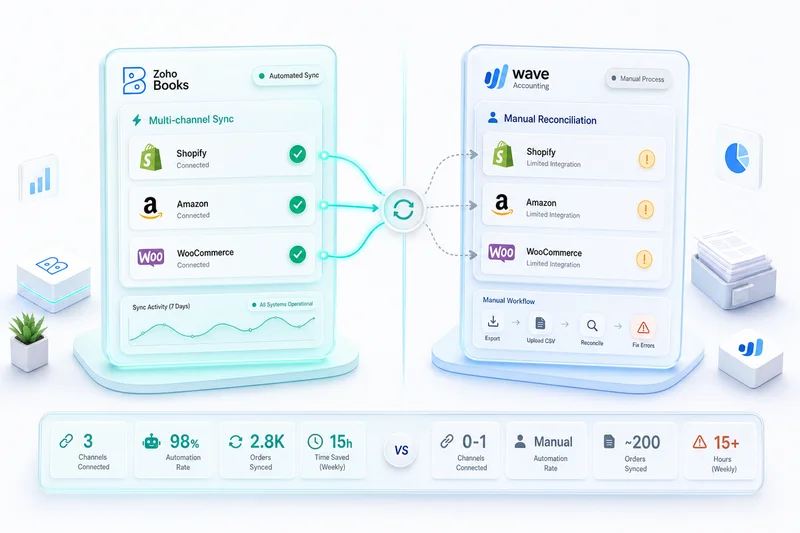
Zoho Books connects to major eCommerce platforms natively. Orders flow in automatically, marketplace fees get categorised correctly, and reconciliation runs on a schedule without manual intervention. This is a meaningful operational difference for any business processing more than 100 orders per week across multiple channels.
GST automation requires add-ons and manual steps
Tally Prime supports GST, but filing GSTR-1, reconciling GSTR-2A, and handling e-invoicing for businesses above the applicable turnover threshold requires either a TSS subscription or third-party extensions. The reconciliation process between Tally's outward supply data and the GSTN portal data is largely manual, which means a member of your team spends hours each month matching records.
Zoho Books generates GST returns directly from transaction data, reconciles GSTR-2A against purchase entries automatically, and submits e-invoices to the IRP without leaving the application. For businesses with high invoice volumes, this automation alone justifies the switch.
Limited collaboration and access control
Tally's concurrent user model means that the number of people who can access the system simultaneously is tied to your license type. Role-based access control is basic: you can restrict access to specific modules, but granular permission settings require TDL customisation.
Zoho Books offers named user licenses with role-based permissions down to the field level. You can give a salesperson access to create estimates but not view profit margins, or give a logistics coordinator access to delivery challan creation without exposing payment data. This level of control matters as your team grows.
Where Zoho Books Outperforms Tally Prime
Automated bank reconciliation
Zoho Books connects directly to over 300 Indian and international bank accounts through open banking feeds. Transactions import daily and are matched to invoices and bills using rule-based automation. Unmatched transactions surface in a review queue rather than getting buried in unreconciled ledgers. The result: bank reconciliation that used to take half a day each month now takes under an hour.
Integrated ecosystem across the full business
For businesses that use Zoho CRM for sales, Zoho Inventory for stock management, or Zoho Analytics for reporting, Zoho Books fits into a single unified data layer. A sales order created in Zoho CRM flows to Zoho Books as an invoice, payment receipt updates both systems simultaneously, and Zoho Analytics pulls consolidated revenue and margin data into dashboards without any data exports.
This level of integration is simply not available in Tally's ecosystem without significant custom development.
Real-time collaboration for accountants and clients
Zoho Books supports accountant access as a dedicated user role, which means your chartered accountant or bookkeeping team can review transactions, pass journal entries, and run reports without requiring a separate Tally installation or remote desktop session. The audit trail records every change with timestamp and user, which simplifies year-end review and supports internal controls.
Zolify's managed accounting clients use this to give their CA direct system access, eliminating the back-and-forth of sending Tally backup files and waiting for corrections to return.
Superior reporting without customisation cost
Zoho Books comes with over 50 built-in financial reports, including profit and loss, balance sheet, cash flow statement, ageing receivables and payables, and GST summary reports. For deeper analysis, Zoho Analytics connects directly to Zoho Books data and allows custom dashboards, cross-entity reporting for multi-entity businesses, and automated report delivery by email.
In Tally, custom reports require TDL (Tally Definition Language) development, which means engaging a Tally partner and paying for each customisation. Zoho Analytics is a no-code drag-and-drop tool that most finance managers can use without developer support.
When Tally Prime Still Makes Sense
Tally Prime is not the wrong choice for every business. There are scenarios where it genuinely fits better.
Your business operates in areas with unreliable internet. Tally's offline-first architecture is a real advantage in locations where connectivity is inconsistent. Until Zoho Books adds robust offline transaction entry, this remains a genuine gap.
Your accountants are deeply Tally-trained and resistant to change. The learning curve for switching accounting software is often more about people than technology. If your accounts team has 15 years of Tally expertise and your business is not growing beyond Tally's capability, the disruption of switching may not be worth the gain.
You have extensive Tally customisations through TDL. Some businesses have invested heavily in Tally customisations for specific industry workflows. Replicating those in Zoho Books may require Zoho Creator custom apps or Zoho Flow automations, which takes time and planning.
Your transaction volumes are low and your workflows are simple. For a sole proprietor or very small partnership with straightforward accounting needs, Tally's perpetual license is predictable cost and requires no ongoing subscription. Zoho Books' free tier covers up to 1,000 invoices per year, but businesses above that threshold will pay a monthly subscription.
The Cost of Staying on Tally When You Have Outgrown It
The clearest sign that a business has outgrown Tally is the number of manual workarounds that have accumulated. A data entry person manually importing orders from Shopify. Another person cross-checking GST return data against the portal. Accountants emailing Tally backup files. A separate Excel model for cash flow forecasting because Tally's cash flow report doesn't pull live bank data.
Each of these workarounds represents a cost: staff time, error risk, and delayed decisions made without current data. Businesses that Zolify has migrated from Tally to Zoho Books have reported reducing month-end close time by 40 to 60 percent and eliminating 10 to 20 hours per month of manual data reconciliation.
The Tally to Zoho Books migration process is more structured than most businesses expect. It is not simply a data export and import. It involves rebuilding the chart of accounts to suit Zoho Books' model, mapping stock configurations to Zoho Inventory warehouses and categories, setting up GST configuration from scratch, importing opening balances as of a clean cutover date, and running parallel systems during a transition period to validate accuracy.
How Zolify Handles Tally-to-Zoho Migrations
Zolify is an Official Zoho Finance Partner with over 100 completed migrations, including more than 30 migrations from Tally ERP 9 and Tally Prime. Our team includes a Chartered Accountant who leads every migration from the accounting side, ensuring that your chart of accounts is structured correctly for Indian statutory reporting from day one rather than being corrected after go-live.
Our Tally migration service follows a six-phase process: pre-migration audit, chart of accounts design, GST and e-invoicing configuration, data preparation and import, parallel-run validation, and post-go-live support. Most single-entity migrations complete in 6 to 10 weeks. We also handle the Zoho Books setup so that your team is working in a correctly configured system, not learning both the software and fixing the setup simultaneously.
For businesses that want ongoing accounting support after the migration, our managed accounting service provides a dedicated accounting team that operates entirely in Zoho Books, handling bookkeeping, GST filing, bank reconciliation, and monthly reporting without requiring you to hire in-house finance staff.
Making the Decision
The Zoho Books vs Tally Prime question usually resolves itself when you map your current pain points against each platform's strengths.
If your biggest friction is manual eCommerce order entry, slow GST reconciliation, limited remote access, or disconnected systems across sales and accounting, Zoho Books addresses all of these directly. The migration involves real effort, but the operational improvement is measurable within the first quarter.
If your business is stable, your accounting needs are simple, your team is fully Tally-trained, and connectivity is occasionally unreliable, Tally Prime continues to serve those requirements well.
The critical mistake is staying on Tally because switching feels complicated, while your team continues to absorb the hidden cost of manual workarounds. If you are spending more than 15 hours per month on data reconciliation between Tally and other systems, the migration pays for itself in the first year.
To understand whether a Tally-to-Zoho migration makes commercial sense for your business, book a free consultation with Zolify. We will review your current setup, estimate the migration scope, and give you a clear picture of the timeline and outcome before you commit to anything.
Zolify is an Official Zoho Finance Partner. For more on structuring your Zoho Books setup after migration, see our Zoho Books setup guide for accountants.
Frequently Asked Questions
Both platforms are GST-compliant, but they handle compliance very differently. Zoho Books has built-in IRP integration for e-invoicing, automated GSTR-1, GSTR-3B, and GSTR-2A reconciliation, and a dedicated e-way bill module, all without third-party add-ons. Tally Prime offers similar coverage through its TallyPrime with TDL extensions and TSS subscription, but setup is more manual and updates depend on your Tally partner's patch cycle. For businesses filing above 200 invoices per month, Zoho Books' automated GST workflows save significant reconciliation time.
Most businesses migrate opening balances as of a clean cutover date rather than importing full Tally transaction history. This is faster and avoids reconciliation issues caused by Tally's voucher structure not mapping directly to Zoho Books' invoice and bill model. Historical Tally data stays accessible in a read-only Tally installation. For businesses that need specific historical transactions in Zoho Books, selective CSV imports are possible for invoices, bills, and payments, though each requires manual field mapping before import.
Zoho Books starts at $15 per month for the Standard plan (up to 3 users, 5,000 invoices per year) and goes to $40 per month for Professional (up to 5 users, unlimited invoices). A free tier supports up to 1,000 invoices per year for very small businesses. Tally Prime uses a perpetual license model: the Silver edition (single-user) costs approximately $215 upfront plus an annual support renewal, while the Gold edition (multi-user) costs several times more. Over a 3-year horizon, Zoho Books' total cost of ownership is typically lower when you factor in TSS renewals, consultant fees for Tally customisations, and the absence of built-in cloud hosting.
Zoho Books is a cloud-first platform and requires an internet connection for most operations. Tally Prime is desktop-based and works fully offline, which is an advantage in locations with unreliable connectivity. Zoho Books does cache recent data in the browser for limited offline viewing, but transaction entry requires connectivity. If your business operates in areas with frequent internet outages, this is a genuine constraint to plan around before switching.
A straightforward single-entity migration with a clean cutover date typically takes 6 to 10 weeks from kickoff to go-live. This includes a pre-migration audit, chart of accounts rebuild, GST configuration, opening balance import, and a parallel-run period. Businesses with complex stock configurations, multiple branches, or extensive historical data requirements should budget 10 to 16 weeks. Zolify's structured migration process, backed by 100-plus completed migrations and a CA on staff, compresses this timeline by handling all data preparation and configuration in parallel.
See exactly where your Shopify, Amazon, or WooCommerce ops are leaking — free.
Get a personalised eCommerce Ops Audit: inventory gaps, accounting leaks, and order-flow bottlenecks — with a Zoho fix roadmap. Delivered in 48 hours, at no cost.