Zoho Books vs Wave Accounting for eCommerce Sellers
Wave Accounting is free and works for early-stage sellers. Once you are managing Shopify orders, Amazon settlements, GST/VAT filings, and multi-channel inventory, Wave's limits surface fast. This is the honest comparison eCommerce sellers need before the decision point.
# Zoho Books vs Wave Accounting for eCommerce Sellers
A WooCommerce seller three years into their business put it plainly: they had always used Wave because it was free and seemed to cover the basics. Then they expanded to Amazon, and every month's close turned into a week-long project. Amazon settlement reports hit the account as single lump deposits. Wave showed the number but could not explain it. The seller split each settlement manually into a dozen line items until their CA discovered they had been categorizing FBA fees wrong for two years. The software was free. The correction was not.
If you are past the startup phase, running more than one channel, and spending real time every month just to get your numbers right, this Zoho Books vs Wave Accounting comparison is for you. The question is not whether Wave is free. It is whether free is actually cheaper.
Disclosure: Zolify is an Official Zoho Authorized Partner with 100+ eCommerce accounting implementations. We migrate sellers from Wave to Zoho Books regularly. This comparison is honest because our clients need accurate information, and we have seen both platforms in production across Shopify, Amazon, and WooCommerce.
Zoho Books vs Wave Accounting: Feature Comparison
| Feature | Wave Accounting | Zoho Books Standard |
|---|---|---|
| Monthly price | $0 (accounting/invoicing) | $20/month (3 users) |
| Shopify integration | None native | Yes, via Zoho Inventory |
| Amazon integration | None native | Yes, via Zoho Inventory |
| WooCommerce integration | None native | Yes, via Zoho Inventory |
| Inventory management | None | Yes, via Zoho Inventory |
| Bank feeds | Manual CSV import | Automated bank feeds |
| Purchase orders | No | Yes |
| Multi-currency | Limited, US-focused | Full (180+ currencies) |
| GST/VAT reporting | Basic US sales tax only | Multi-region GST/VAT built in |
| Audit trail | No | Yes |
| Support model | Email only, US business hours | Email, chat, and phone |
The Wave Trap: Why Free Accounting Costs More as You Grow
Wave's appeal is real. For a seller just getting started on Shopify or Etsy, free accounting that covers invoicing, basic expense tracking, and bank import is a sensible choice. At that stage, Wave does what you need.
Wave was built for simple bookkeeping. The more your business looks like a real multi-channel eCommerce operation, the more the gaps show. The features that seemed optional at launch become critical, and Wave does not have them.
The real cost of Wave is not the subscription fee. It is the manual work the platform requires, the errors that accumulate inside that manual work, and the compliance risk those errors create over time.
Manual Bank Reconciliation With No Automation
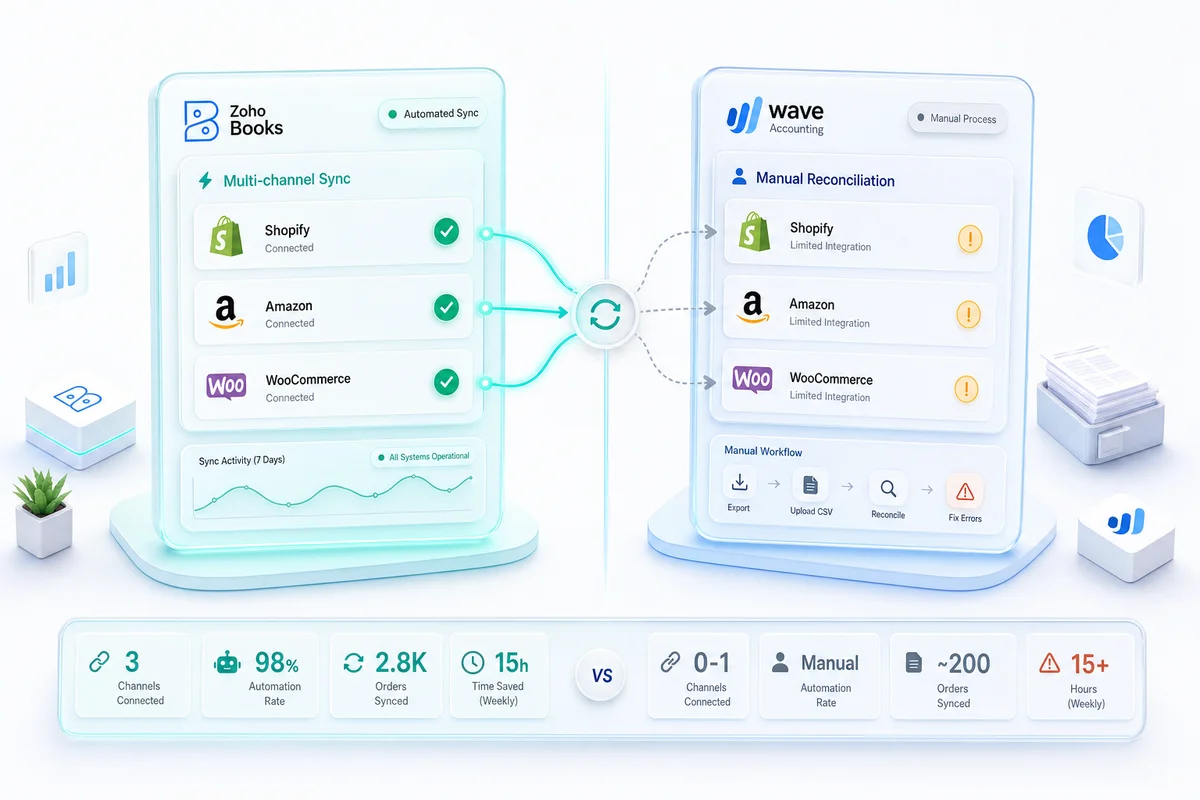
Wave does not offer automated bank feeds in the way that modern cloud accounting platforms do. Transactions arrive via CSV import from your bank or through a third-party connection that pulls data on a delay. For a seller managing two or three channels with separate payment processors and payout accounts, this becomes a monthly data-wrangling session.
A Shopify seller on Shopify Payments, a second Amazon payout account, and a PayPal account for WooCommerce faces three separate import processes every month. That is before splitting Amazon's bundled settlement report into its component line items, which Wave cannot do automatically.
No Native eCommerce Integrations
Wave has no native connections to Shopify, Amazon Seller Central, WooCommerce, eBay, or Etsy. Transactions arrive as bank deposits, stripped of the detail that makes eCommerce accounting meaningful.
An Amazon settlement lands in Wave as one number. It should arrive as: gross sales, referral fees, FBA fulfillment fees, advertising costs, reimbursements, refunds, and adjustments, each mapped to the correct account in your chart of accounts. Getting that level of detail out of Wave requires either a manual split on every settlement, a third-party middleware tool costing $30-80 per month, or both.
No Inventory or Purchase Order Management
Wave cannot track inventory. For a product-based business, that means COGS calculations are manual, returns are hard to account for accurately, and purchase orders live in a spreadsheet rather than the accounting system.
Shopify tracks inventory on the storefront side. Amazon tracks FBA stock in its own system. Wave does not connect to either, so the seller bridges the gap manually every month.
What Zoho Books Provides for eCommerce Sellers
Multi-Channel Integration for Shopify, Amazon, and WooCommerce
Zoho Books connects directly to Shopify through Zoho Inventory. When an order lands on the storefront, stock adjusts automatically and the sale posts to Zoho Books with the correct account codes. No CSV import, no manual split, no reconciliation backlog building up through the month.
For Amazon FBA sellers, Zoho Inventory connects to Amazon Seller Central and handles FBA inventory separately from warehouse stock. FBA fees map to sub-accounts in the chart of accounts, and Amazon settlement reconciliation runs through a configurable rules engine rather than a monthly manual process.
WooCommerce sellers have the same integration available. Orders sync, inventory adjusts, and COGS posts automatically across all three storefronts simultaneously when a seller runs Shopify, Amazon, and WooCommerce in parallel.
Automated Bank Feeds
Zoho Books connects directly to bank accounts and credit cards through automated bank feeds. Transactions pull in daily without manual imports. Rules apply automatically so that common payment processor deposits categorize correctly without intervention. For a seller managing multiple accounts and payout sources, reconciliation becomes a confirmation step rather than a data-entry project.
GST, VAT, and Multi-Currency Compliance
Selling on Amazon UK, Amazon EU, or Etsy into Canada creates tax obligations Wave cannot handle. Zoho Books supports GST filing workflows, VAT reporting by jurisdiction, and threshold-based compliance tracking as built-in features, not add-ons.
Multi-currency support covers 180+ currencies with automatic exchange rate updates. A seller receiving USD from Amazon US, GBP from Amazon UK, and EUR from an EU marketplace can reconcile all three in a single system with accurate foreign currency accounting. Wave's multi-currency support is limited and US-focused; it was not designed for sellers operating across multiple international marketplaces.
Audit Trail for CA-Ready Accounting
Zoho Books maintains a full audit trail on every transaction: who created it, who modified it, when, and what changed. For eCommerce sellers working with a bookkeeper or CA, this is standard practice. Wave does not have it. When a CA asks why a transaction was edited or a past settlement needs to be traced, Wave gives you nothing to point to.
Total Cost Comparison: Wave Free vs Zoho Books
Wave's zero subscription cost is real, but it is not the complete picture.
| Cost component | Wave | Zoho Books Standard |
|---|---|---|
| Software subscription | $0/month | $20/month |
| eCommerce channel integration | Third-party tool required ($30-80/month) | Included via Zoho Inventory |
| Bank reconciliation labor | 8-15 hours/month manual | 2-3 hours/month automated |
| GST/VAT compliance tooling | External tool or manual | Built in |
| Accountant correction hours | High (error-prone manual data) | Low (clean automated data) |
For a seller paying a bookkeeper or CA at $75 per hour, five additional correction hours each month equals $375. That is more than 18 times the Zoho Books Standard subscription cost. The software price is not the comparison that matters. The labor cost is.
Zolify provides managed Zoho Books implementations for eCommerce sellers who want someone else to handle the move rather than figuring it out themselves. That means building a chart of accounts structured for eCommerce from day one: per-channel revenue, marketplace fee sub-accounts, COGS by product line. Zoho Inventory connects to each of your storefronts before go-live. Historical Wave data comes across, and ongoing accounting support continues after the migration.
Zolify has completed 100+ eCommerce accounting implementations with a CA validating every migration. If your books need to hold up for a tax filing, a bank loan, or an investor review, having a CA on the implementation is not a nice-to-have.
Who Should Stay on Wave, Who Should Move to Zoho Books
Stay on Wave if:
You are pre-revenue or under $100,000 in annual gross merchandise value. You sell on a single channel with low transaction volume, under 100 orders per month. You have no international tax obligations and carry no physical inventory. Your monthly close takes under two hours and produces numbers you trust.
Wave is genuinely good software for this profile. Switching costs time and money. If Wave handles your current needs without friction, the switch is not warranted yet.
Move to Zoho Books when:
You are adding a second sales channel: Shopify plus Amazon, WooCommerce alongside an existing store. Monthly reconciliation is taking more than three hours and you are not confident the numbers are right. You are selling into GST or VAT territory: Canada, Australia, the UK, or any EU market. You are buying from suppliers and need purchase orders, but tracking them in a spreadsheet.
Your CA is spending their time cleaning your data instead of reviewing your actual P&L. You are crossing $250,000 in annual revenue and need to know which channel is actually profitable.
Any one of these is the point where Wave costs you more than Zoho Books does.
Migrate From Wave to Zoho Books with Zolify
If your Wave data is reasonably clean, the migration is not complicated. Wave exports transactions, invoices, and customer records as CSV files. You build the chart of accounts in Zoho Books, import the historical data, connect your storefronts via Zoho Inventory, and run one parallel close to confirm your opening balances land correctly.
Most Wave-to-Zoho migrations take three to five weeks. The time is mostly in designing the chart of accounts properly for eCommerce, not in moving the data itself.
If you are hitting Wave's limits and want to assess whether Zoho Books is the right move for your operation, the starting point is an eCommerce Ops Audit. Zolify reviews your current accounting setup, identifies the gaps, and gives you an honest recommendation, including whether the timing and transaction volume make a switch worth it now or in six months.
For sellers also evaluating other accounting platforms in the same price range, see Zoho Books vs FreshBooks for eCommerce Sellers for a direct comparison of Wave's main paid alternative.
For eCommerce sellers comparing Xero, see Xero vs Zoho Books for eCommerce Sellers — which covers Xero's inventory gap and connector stack cost for Shopify, Amazon, and WooCommerce operators.
Frequently Asked Questions
Wave Accounting works for eCommerce sellers at the early stage: pre-revenue, low transaction volume, single channel. Once you are managing Shopify settlements, Amazon FBA inventory, multi-currency payouts, or GST/VAT compliance across multiple countries, Wave hits structural limits. It has no native eCommerce integrations, no inventory management, and no GST/VAT filing tools built in.
Zoho Books connects to Shopify natively through Zoho Inventory. Orders sync automatically, inventory adjusts in real time, and COGS posts to accounting without manual entry. Wave has no native Shopify integration. Shopify sellers on Wave reconcile payouts manually from bank feeds, which works at low volume but becomes unmanageable past a few hundred orders per month.
Wave Accounting supports basic sales tax for US sellers, including rate configuration and tax reports. It does not support GST filing workflows, VAT reporting by jurisdiction, or the threshold-based compliance that Amazon and Etsy sellers need for UK, EU, Canada, and Australia markets. Zoho Books handles GST/VAT reporting across multiple regions as a built-in feature.
Switch when you hit any of these: expanding to a second sales channel such as Shopify plus Amazon, crossing $250,000 in annual revenue, starting to sell into GST or VAT jurisdictions like Canada, Australia, UK, or the EU, needing purchase orders for supplier management, or spending more than three hours per month on manual bank reconciliation. Those are the points where Wave's free tier costs more in labor than Zoho Books costs in subscription fees.
Wave's core accounting is free. Zoho Books starts at $20/month on the Standard plan, covering 3 users. The Professional plan, which includes deeper automation and advanced inventory workflows, is $40/month for 5 users. For growing eCommerce sellers, Zoho Books Standard is the starting point. The comparison shifts when you factor in the time Wave's manual workflows consume: at $20-40/month, Zoho Books typically pays for itself in saved reconciliation hours within the first month.
See exactly where your Shopify, Amazon, or WooCommerce ops are leaking — free.
Get a personalised eCommerce Ops Audit: inventory gaps, accounting leaks, and order-flow bottlenecks — with a Zoho fix roadmap. Delivered in 48 hours, at no cost.