Salesforce to Zoho CRM Migration: Complete Guide (2026)
Step-by-step guide to migrating from Salesforce to Zoho CRM. Covers data mapping, field types, automation rebuilds, pricing comparison, and common pitfalls.
If your Salesforce bill keeps climbing and the platform feels like it needs a full-time admin just to keep the lights on, you are not the only one having that conversation.
Salesforce's current 2026 list pricing puts Enterprise at $175 per user per month — and that number has risen every year since 2021. For a 25-person sales team, that is over $52,000 a year before add-ons. And October is when that bill becomes a budget line item: enterprise IT teams finalize software spend in Q4 for the following fiscal year.
Zoho CRM Enterprise? $40 per user per month. Same team, same tier, $12,000 a year.
But here is the thing: swapping CRM software is easy to say and hard to do. Your pipeline, your customer history, your automations, your team's daily habits, all of it has to move from one system to another without dropping a single record or missing a follow-up.
We have done this 100+ times at Zolify, including Salesforce orgs with dozens of custom objects, multi-currency pipelines, and heavy Apex code. This guide walks through exactly what transfers, what needs manual work, and how to pull it off without your sales team losing a step.
Why Companies Are Leaving Salesforce
Cost is usually what starts the conversation. But it is rarely the only reason people leave.
The pricing gap is real
2026 list pricing — verify current rates directly with Salesforce and Zoho before contract renewal
| Edition | Salesforce (per user/month) | Zoho CRM (per user/month) | Annual savings (25 users) |
|---|---|---|---|
| Entry-level | $25 (Starter Suite) | $14 (Standard) | ~$3,300 |
| Mid-tier | $100 (Pro Suite) | $23 (Professional) | ~$23,100 |
| Enterprise | $175 (Enterprise) | $40 (Enterprise) | ~$40,500 |
| Top tier | $350 (Unlimited) | $52 (Ultimate) | ~$89,400 |
These are just base license costs. The real Salesforce bill shows up in add-ons: CPQ, Einstein Analytics, live chat, advanced reporting, API access on lower tiers. All extra. Zoho CRM includes AI (Zia), omnichannel communication, inventory management, and Canvas design tools in its base plans.
Worth knowing about Zoho One: For $37 per user per month (billed annually), you get 45+ integrated apps: CRM, helpdesk, accounting, project management, email marketing, HR, and more. Try pricing that out in the Salesforce ecosystem. You would be looking at several hundred dollars per user.
Complexity adds up fast
A 2024 Salesforce Ben survey found that 44% of Salesforce developers say resource constraints are holding their teams back. It shows. Many mid-size companies quietly budget for a dedicated Salesforce admin — $80,000 to $130,000 per year in the US — just to keep the lights on. With Zoho CRM, your ops team handles most configuration without outside help.
You keep buying more Salesforce
Need customer support? Buy Service Cloud. Marketing automation? Marketing Cloud. Every addition pulls you deeper in and makes leaving harder. Zoho's suite works together out of the box: one platform, one login, a fraction of the cost.
Why Q4 Is the Right Time to Make This Decision
Software spending follows budget cycles. Most enterprise teams approve next year's software spend in Q4. Salesforce customers who do not use that window end up renewing on autopilot.
Here is the timing problem: Salesforce contracts typically auto-renew in Q1. Miss the Q4 planning cycle and you are locked in for another year before you can renegotiate or switch. Start the conversation in October or November and you have the renewal deadline as actual leverage. Start in January and you have already signed for another year.
Running the 3-year ROI
The migration itself costs money and time. That is not a reason to stay — it is a reason to calculate accurately before committing.
25-person sales team, Salesforce Enterprise → Zoho CRM Enterprise
| Year 1 | Year 2 | Year 3 | |
|---|---|---|---|
| Salesforce license | $52,500 | $52,500+ | $52,500+ |
| Zoho CRM license | $12,000 | $12,000 | $12,000 |
| Migration cost (est.) | $10,000–$25,000 | $0 | $0 |
| Net saving | $15,500–$30,500 | $40,500 | $40,500+ |
| Cumulative saving | $15,500–$30,500 | $56,000–$71,000 | $96,500–$111,500 |
Salesforce price increases an average of 6-9% per year. Zoho CRM has held pricing flat for three consecutive years.
The break-even point for most mid-size orgs is before the end of Year 1. After that, every dollar of Salesforce overage goes back to the business.
The enterprise planning timeline
If your Salesforce contract renews in January or February:
- October: Internal decision — confirm migration is the right move, get budget approved
- November: Engage a migration partner, begin Salesforce org audit
- December–January: Data migration and automation rebuilds
- February: Parallel run — both systems active
- March: Full cutover, Salesforce decommissioned before next renewal
We have done this full sequence in 10 weeks for mid-size eCommerce orgs. The data moves in a weekend. The planning and rebuilds are what take time — which is why October is when to start. If your operations team is also prepping for Q4 peak season, see how other eCommerce operators prepare their Zoho stack before peak season so both workstreams land without conflict.
If your Salesforce contract renews later in the year, the same logic applies one quarter earlier. Check your renewal date before reading further.
What Zoho CRM's Salesforce Migration Tool Actually Does
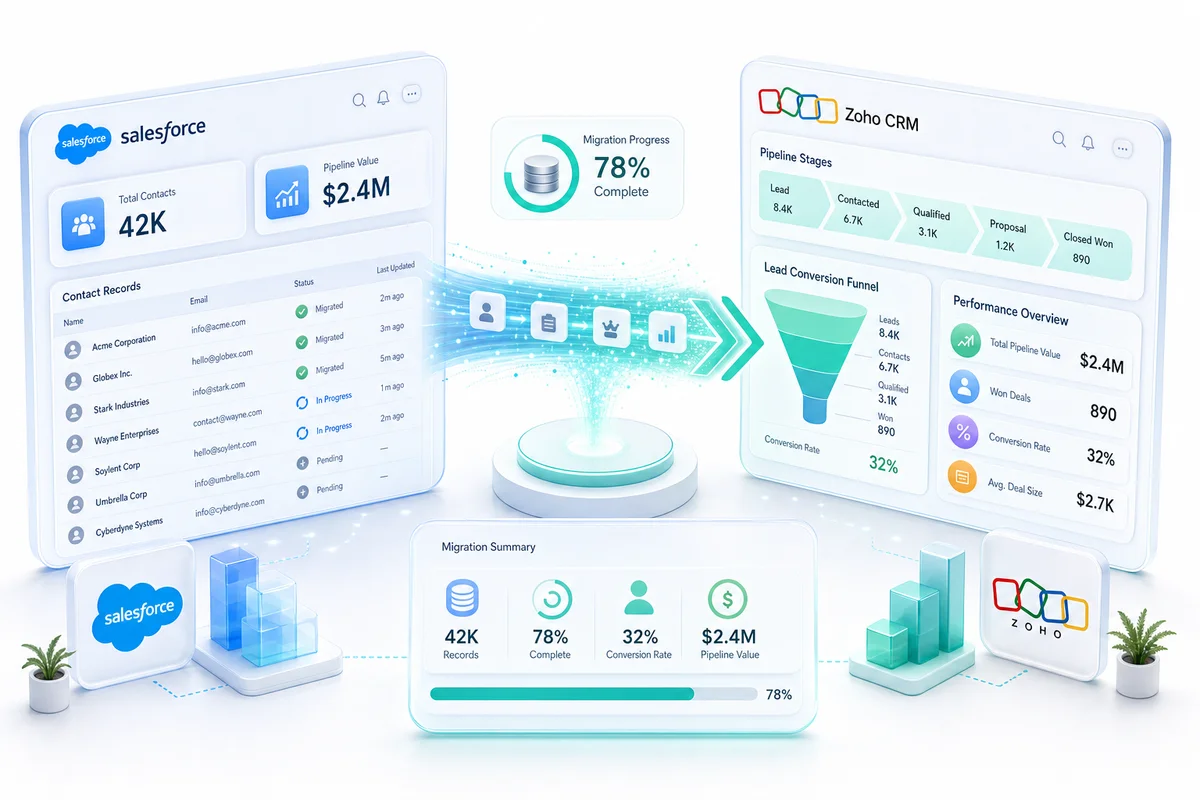
Zoho CRM has a Salesforce migration wizard built right in. You will find it under Setup > Data Administration > Import > Salesforce. Here is what it actually does (and does not do).
Supported modules (19 total)
Core: Users, Leads, Accounts, Contacts, Deals (Opportunities), Campaigns, Notes, Tasks, Events, Calls, Attachments
Advanced: Cases, Solutions, Products, Quotes, Sales Orders, Invoices, Purchase Orders, Vendors, Price Books, Competitors
How it works
- Export your Salesforce data as CSV files (or a ZIP package with attachments)
- Upload to Zoho CRM's migration wizard
- The tool auto-detects modules based on CSV headers
- Auto Map matches your Salesforce columns to Zoho CRM fields
- You review and adjust the mapping, especially for mandatory fields
- Set default values for any empty required fields
- Run the migration (you can pause and edit during execution)
- Validate records in each module after completion
What it handles well
- Standard module records across all 19 supported modules
- Field values where CSV headers match Zoho field names
- Record ownership (mapped to active Zoho users)
- Basic relationships between records (Account-Contact, Account-Deal)
- Attachments via a dedicated
_Attachments_folder in the ZIP
What it does not handle
- Workflow rules, automation, and business logic: none of it transfers
- Reports and dashboards: must be rebuilt from scratch
- Apex triggers and custom code: must be rewritten in Deluge
- Approval processes: must be recreated in Zoho's approval system
- Formula fields: must be manually rebuilt using Zoho's formula syntax
- Roll-up summary fields: no direct equivalent; requires Deluge custom functions
Data Mapping: Salesforce to Zoho CRM
This is the part most people want to see first: what goes where.
Object-to-module mapping
| Salesforce Object | Zoho CRM Module | Notes |
|---|---|---|
| Leads | Leads | Direct mapping |
| Contacts | Contacts | Direct mapping |
| Accounts | Accounts | Direct mapping |
| Opportunities | Deals | Stage values must match |
| Cases | Cases | Or Zoho Desk for full helpdesk |
| Campaigns | Campaigns | Direct mapping |
| Products | Products | Direct mapping |
| Price Books | Price Books | Direct mapping |
| Quotes | Quotes | Direct mapping |
| Tasks | Tasks | Direct mapping |
| Events | Events | Direct mapping |
| Notes | Notes | Direct mapping |
| Attachments | Attachments | Requires ZIP folder structure |
| Custom Objects | Custom Modules | Imported with _c suffix |
Field type mapping
Most standard field types transfer without issues. A few need extra attention.
| Salesforce Field Type | Zoho CRM Equivalent | Transfer Status |
|---|---|---|
| Text | Single Line / Multi Line | Clean transfer |
| Number | Number | Clean transfer |
| Currency | Currency | Clean transfer |
| Date / DateTime | Date / DateTime | Clean transfer (format standardization may be needed) |
| Checkbox | Checkbox | Clean transfer |
| Picklist | Pick List | Values must be pre-created in Zoho |
| Multi-Select Picklist | Multi-Select | Delimiter differences need transformation |
| Lookup / Master-Detail | Lookup | Relationships may need recreation |
| Formula Fields | Formula Fields | Must be manually recreated in Zoho syntax |
| Roll-Up Summary | No direct equivalent | Requires Deluge custom functions |
| Auto Number | Auto Number | Cannot be created during migration |
| Rich Text Area | Multi Line (Rich Text) | May lose some formatting |
Important: Multi-select picklist values use semicolons as delimiters in Salesforce. Zoho may expect a different format. You will need a data transformation step (a quick find-and-replace in your CSV or a simple script) to handle this.
Step-by-Step Migration Process
Step 1: Audit your Salesforce org
Before you export a single record, document everything that exists in your Salesforce org.
- Custom objects and fields. List every custom object, every custom field, and note the field type. This determines how much pre-configuration Zoho CRM needs.
- Automation. Document every workflow rule, Process Builder flow, Apex trigger, validation rule, and approval process. These will need to be rebuilt manually.
- Reports and dashboards. Screenshot or list every report and dashboard your team uses daily. These do not transfer.
- Integrations. List every connected app: Slack, QuickBooks, Mailchimp, DocuSign, custom APIs. Each one needs a Zoho equivalent or a Zoho Flow connection.
- User roles and permissions. Map out your role hierarchy, profiles, and permission sets. Zoho uses a different hierarchy model.
Pro tip: Salesforce's Setup Audit Trail (Setup > Security > View Setup Audit Trail) shows recent configuration changes. Export this to make sure you capture everything.
Step 2: Clean up your data
Moving messy data from one CRM to another just gives you messy data in two places.
- Deduplicate. Run Salesforce's built-in duplicate management or a tool like Cloudingo. Do this before export, not after import.
- Reassign orphaned records. Records owned by deactivated users must be reassigned to active users. Zoho requires active user mapping during import.
- Standardize picklist values. Inconsistent values (e.g., "US", "USA", "United States") will cause mapping failures. Pick one format and clean it up.
- Remove test data. Sandbox records, test leads, and demo accounts have no place in your production migration.
Step 3: Set up your Zoho CRM organization
Configure Zoho CRM before importing any data.
- Create your organization with the correct base currency and fiscal year
- Set up roles and profiles that mirror your Salesforce hierarchy
- Create all custom modules that correspond to your Salesforce custom objects
- Add custom fields with the correct field types
- Pre-create all picklist values so imported data maps correctly
- Configure layouts, validation rules, and mandatory field requirements
This step determines the quality of your entire migration. Rushing it leads to failed imports, unmapped fields, and hours of manual cleanup.
Step 4: Export data from Salesforce
You have several export options depending on your org size.
- Data Export Service (Setup > Data > Data Export). Generates CSV files in a ZIP. Available every 7 days on Enterprise/Unlimited or every 29 days on lower editions. The ZIP stays available for 48 hours. Does not consume API limits.
- Data Loader. Free desktop app for Windows and Mac. Supports SOQL queries and Bulk API (up to 5 million records per batch, 150 million total via Bulk API 2.0). Best for selective exports.
- Bulk API 2.0. Best for large datasets. Handles up to 150 million records.
For attachments: Export ContentDocument and ContentVersion objects. Salesforce stores attachments in base64 encoding, and they need to be decoded before import into Zoho. Place decoded files in an _Attachments_ folder with a CSV mapping each file to its parent record.
Step 5: Run a trial migration
Never run a full migration on your first attempt.
- Pick 100 to 500 records from your most complex module (usually Opportunities/Deals)
- Upload to Zoho CRM's Salesforce migration wizard
- Review the auto-mapped fields and check for mismatches and unmapped columns
- Import the batch and verify:
- Record counts match
- Field values populated correctly
- Lookup relationships intact (Account linked to Contact, Contact linked to Deal)
- Attachments accessible
- Picklist values mapped correctly
Fix any mapping issues before proceeding to the full import.
Step 6: Execute the full migration
Import order matters. Relationships break if you import child records before parent records.
Follow this sequence:
- Users: Map Salesforce users to Zoho CRM users
- Accounts: The parent object for most relationships
- Contacts: Linked to Accounts
- Deals (Opportunities): Linked to Accounts and Contacts
- Cases: Linked to Contacts and Accounts
- Campaigns: Independent, but campaign members link to Leads/Contacts
- Products and Price Books: Independent
- Quotes, Sales Orders, Invoices: Linked to Deals and Products
- Tasks and Events: Linked to Contacts, Deals, or Accounts
- Notes: Linked to parent records
- Attachments: Linked to parent records via the mapping CSV
Watch for the 5,000-record skip threshold. Zoho's migration tool pauses if 5,000+ records fail in a single module. This usually means missing mandatory field values or format mismatches. Fix the source CSV and re-run.
Step 7: Rebuild automations and reports
This is where most of the time goes. Rebuilding automations often takes longer than moving the data.
| Salesforce Feature | Zoho Equivalent | Rebuild Effort |
|---|---|---|
| Workflow Rules | Workflow Rules | Medium: logic must be rebuilt |
| Process Builder / Flows | Blueprint | High: different approach entirely |
| Apex Triggers | Deluge Custom Functions | High: completely different language |
| Validation Rules | Validation Rules | Medium: recreate each rule individually |
| Approval Processes | Approval Processes | Medium: similar concept, different configuration |
| Reports | Reports Module | Medium: different report builder |
| Dashboards | Analytics Dashboard | Medium: rebuild from scratch |
| Email Templates | Email Templates | Low: quick to recreate |
| Page Layouts | Layouts | Medium |
| Record Types | Layouts + Conditions | Medium |
Pro tip: Prioritize automations by business impact. Start with the workflows your sales team hits daily (lead assignment rules, deal stage notifications, task creation). Rebuild less-critical automations after go-live.
Step 8: Train your team and run in parallel
Do not flip the switch overnight. Seriously.
- Run both systems for 2 to 4 weeks. Your sales team enters data in Zoho CRM. Salesforce stays read-only, just for reference.
- Do hands-on training. The interface is different. Navigation works differently, Opportunities are now called Deals, and common actions live in different places. Give people time to find their footing.
- Check numbers daily. Compare pipeline value, lead counts, activity logs, and report outputs between both systems. Catch discrepancies early.
- Pick 2 to 3 super users. Train them deeply so they can help the rest of the team during the switch.
Keep Salesforce active until everyone confirms Zoho CRM is working. Only cancel the Salesforce subscription after your parallel run is done and validated.
Common Pitfalls and How to Avoid Them
1. Wrong import order breaks relationships
Importing Contacts before Accounts means the Account lookup field has nothing to link to. Always follow the parent-first import sequence.
2. Deactivated user ownership
Salesforce records owned by former employees will fail to import because Zoho requires mapping to active users. Reassign these records before export or map them to a catch-all user during import.
3. Picklist value mismatches
If your Salesforce Opportunity has a stage called "Negotiation/Review" but Zoho has "Negotiation" as the picklist value, the field imports blank. Pre-create every picklist value in Zoho exactly as it appears in Salesforce.
4. Lost opportunity stage history
Salesforce stores stage history as separate OpportunityHistory records. Zoho CRM has no equivalent object. If you need this data, export it and store it in a custom multi-line field or as notes on the Deal record.
5. Formula fields silently fail
Formula fields cannot be migrated. They import as blank because the formula logic does not transfer. Identify all formula fields during your audit and manually recreate them in Zoho using Zoho's formula syntax.
6. Underestimating the automation rebuild
This one catches people off guard. A Salesforce org with 30 workflow rules, 10 flows, and 5 Apex triggers can easily need 2 to 3 weeks of automation work alone. The data moves fast. The business logic takes much longer.
Get a Free Salesforce Migration Assessment
7. Integration gaps
Every Salesforce AppExchange integration needs a Zoho equivalent. Salesforce has 7,000+ apps on AppExchange; Zoho Marketplace has around 1,500. That gap matters if you rely on niche tools. Check that your critical integrations exist, or can be built through Zoho Flow or custom APIs, before you commit.
What Zoho CRM Does Better Than Salesforce
The cost savings are obvious. But Zoho CRM also does some things that Salesforce simply does not offer, or charges a premium for.
- Built-in omnichannel. Live chat, telephony, social media, and messaging apps are included in the base price. Salesforce charges extra for each channel.
- Canvas Design Studio. Drag-and-drop CRM view designer that lets you customize record layouts without code. No Salesforce equivalent exists at this level.
- Blueprint. Visual process enforcement that guides reps through each stage of a deal with mandatory actions. More intuitive than Salesforce's Flow Builder for sales processes.
- Zia AI included. Lead scoring, deal predictions, anomaly detection, and sentiment analysis come bundled at no extra cost on Enterprise and above. Salesforce charges $50+ per user per month for Einstein AI features.
- Native inventory management. Quotes, Sales Orders, Purchase Orders, and Invoices are built into Zoho CRM Professional and above. Salesforce requires CPQ as a paid add-on.
- CommandCenter. Coordinates sales, support, and marketing actions across departments from one place. Useful when a deal involves handoffs between teams.
- Lower admin overhead. Most configuration is low-code. You do not need a certified admin on payroll just to keep things running.
eCommerce-Specific Migration Scenarios
Most Salesforce-to-Zoho migration guides treat CRM as a generic sales tool. For eCommerce businesses — sellers on Shopify, Amazon, WooCommerce, or wholesale distributors managing dealer networks — the migration has specific wrinkles worth planning for.
Salesforce CPQ → Zoho Inventory + Quotes
If you use Salesforce CPQ to manage product configurations, pricing rules, or complex quote workflows for wholesale or B2B orders, the migration needs a Zoho counterpart. Zoho CRM's native Quotes and Sales Orders handle standard product-based quoting well. For more complex pricing (volume tiers, dealer-specific price books, multi-currency wholesale), the right destination is Zoho Inventory alongside Zoho CRM — with price books synced between both.
What moves cleanly: product catalog, standard price books, active quotes, and historical orders all land in the right Zoho objects with standard mapping.
What needs rebuilding: CPQ configuration rules, discount approval workflows, and dynamic pricing logic all need to be manually recreated — in Zoho CRM's Price Rules and Approval Processes, or via Deluge custom functions for anything complex.
For eCommerce sellers managing B2B wholesale alongside DTC, the opportunity tracking inside Zoho's B2B eCommerce setup gives you channel-level pipeline visibility that Salesforce CPQ required extra licensing to achieve.
Opportunity tracking for wholesale channels
Salesforce uses Opportunities as the primary revenue tracking object. Zoho CRM calls them Deals, but the bigger difference is how Zoho connects CRM to actual order flow for Shopify, Amazon, and WooCommerce sellers.
In Salesforce, connecting opportunity data to actual channel orders typically requires middleware or expensive AppExchange connectors. In Zoho CRM Professional and above, you can link Deals directly to Sales Orders, which sync with Zoho Inventory's channel-level order records. For a wholesale distributor managing separate pipelines for their Shopify B2B store, their Amazon Business account, and their direct dealer network, this means:
- One Deal record per wholesale account (not one per order)
- Channel-specific revenue attribution without a separate BI tool
- Post-sale handoff to fulfillment operations without leaving Zoho
This is the setup we build for eCommerce operators who want CRM and operations talking to each other, not two separate tools that require an export to reconcile. If you are moving from Salesforce partly because the CRM-to-operations gap has become painful, see how Zoho CRM handles post-purchase retention for Shopify and Amazon sellers — that is the downstream payoff once the migration is done.
Multi-channel seller: unified CRM across Shopify, Amazon, WooCommerce
Salesforce does not have native eCommerce connectors. Every Shopify or Amazon integration runs through AppExchange, and each one is a separate maintenance burden. Zoho CRM connects to Shopify, WooCommerce, and Amazon through Zoho Flow and direct API integrations — all maintained within a single Zoho infrastructure.
For Q4 specifically: if you are running promotions across multiple channels, Zoho CRM's segmentation by order source means your sales team can track wholesale deal status while marketing tracks B2C campaign performance — from the same customer record. Getting that setup live before your peak season requires lead time. Migration started in October can realistically be operational by the January–February window.
What Salesforce Does Better (Be Honest About It)
We would not be doing our job if we did not mention what you might miss.
- AppExchange ecosystem. 7,000+ third-party integrations versus Zoho's 1,500. If you rely on niche industry apps, verify they exist in Zoho's ecosystem first.
- Enterprise scalability. For companies with 1,000+ users and deeply layered org structures, Salesforce handles the complexity better.
- Apex programming language. More powerful than Deluge for complex custom logic. If your org has heavy Apex customization, the Deluge rewrite is a significant effort.
- Industry clouds. Health Cloud, Financial Services Cloud, and Manufacturing Cloud have specialized features that Zoho does not match out of the box.
- Sandbox environments. Full and partial sandboxes for testing are available on more Salesforce tiers. Zoho offers sandboxes only on Enterprise and above.
If any of these matter for your specific setup, weigh them carefully before committing to the move.
Realistic Timelines by Org Size
| Org Size | Record Count | Timeline | Key Variables |
|---|---|---|---|
| Small | Under 1,000 | 1-2 weeks | Minimal customization, few integrations |
| Medium | 1,000-50,000 | 4-6 weeks | Custom fields, some workflows, a few integrations |
| Large | 50,000+ | 6-12 weeks | Extensive custom objects, Apex code, complex approvals, many integrations |
Here is what surprises most people: the actual data transfer (uploading CSVs and running the import) usually finishes in 1 to 2 days. You could do it over a weekend. Everything else in the timeline is planning, cleanup, automation rebuilds, and training.
Typical phase breakdown (medium org)
| Phase | Duration | What Happens |
|---|---|---|
| Audit and planning | 1 week | Document objects, fields, automations, integrations |
| Data cleanup | 1 week | Deduplicate, standardize, reassign |
| Zoho CRM setup | 1 week | Configure modules, roles, fields, layouts |
| Data migration and testing | 1 week | Export, trial import, full import, validate |
| Automation rebuilds | 1-2 weeks | Workflows, Blueprints, Deluge functions, reports |
| Training and parallel run | 2-4 weeks | User training, dual-system operation, validation |
DIY vs. Hiring a Migration Partner
When DIY works:
- Small org with under 1,000 records
- Minimal custom objects and fields
- Few or no Apex triggers / Process Builder flows
- Your team has time and technical comfort
When you need a partner:
- More than 10 custom objects
- Any Apex code that needs Deluge rewriting
- Multi-currency or multi-org setups
- Complex approval processes
- Heavy file/attachment libraries
- Tight timeline with no room for errors
- Your sales team cannot afford pipeline disruption
We have done this 100+ times at Zolify, including Salesforce orgs with 50+ custom objects, multi-currency pipelines, and heavy Apex logic. Every migration comes with a zero data loss guarantee, and we keep both systems running side by side until your team says they are ready. If you are in the Q4 planning window, the time to start is now — Salesforce contracts renew fast and migration timelines are not compressible on the back end.
Talk to a Salesforce Migration Expert at Zolify →
Also in this series: Microsoft Dynamics to Zoho CRM migration | HubSpot to Zoho CRM migration | Excel to Zoho CRM migration | Legacy CRM to Zoho CRM migration
Frequently Asked Questions
A small org with fewer than 1,000 records can typically complete the migration in 1 to 2 weeks. Mid-size orgs with 1,000 to 50,000 records usually need 4 to 6 weeks. Large orgs with 50,000+ records, extensive custom objects, Apex code, and complex approval processes can take 6 to 12 weeks. The actual data transfer often finishes in a day or two. Most of the timeline is spent on planning, automation rebuilds, and user training.
No, you should not lose data if the migration is planned and executed correctly. Standard records like Leads, Contacts, Accounts, and Opportunities transfer cleanly through Zoho's built-in migration tool. The risk areas are custom objects, file attachments, and activity history, which need careful handling. Running a trial migration and validating record counts before cutting over eliminates the risk of data loss.
Yes. Zoho CRM has a dedicated Salesforce migration wizard under Setup > Data Administration > Import > Salesforce. It supports 19 standard modules including Leads, Contacts, Accounts, Deals, Cases, Products, Quotes, and Attachments. You upload CSV exports from Salesforce, and the tool auto-maps fields where column headers match. Custom objects import as custom modules with a _c suffix.
Workflow rules, Process Builder flows, approval processes, Apex triggers, validation rules, reports, dashboards, email templates, and page layouts do not transfer. These must be manually recreated in Zoho CRM using its equivalent features like Blueprint, Deluge custom functions, and the Zoho report builder. The data migrates, but the business logic does not.
At the enterprise tier, Zoho CRM costs $40 per user per month compared to Salesforce Enterprise at $175 per user per month as of 2026 list pricing — a 77% reduction per user. For a 25-person sales team, that is a difference of roughly $40,500 per year on licensing alone. Factor in lower admin overhead, fewer paid add-ons, and the Zoho One bundle at $37 per user (billed annually) for 45+ apps, and total cost savings typically range from 40% to 70%. Q4 is the right time to run this calculation: Salesforce contracts typically renew in Q1, so decisions made now take effect before your next renewal.
See exactly where your Shopify, Amazon, or WooCommerce ops are leaking — free.
Get a personalised eCommerce Ops Audit: inventory gaps, accounting leaks, and order-flow bottlenecks — with a Zoho fix roadmap. Delivered in 48 hours, at no cost.