How AI Is Changing eCommerce Operations in 2026
AI is no longer a future promise for eCommerce sellers. It's running in inventory forecasting, anomaly detection, and customer support triage right now. This guide covers how Zoho's AI layer works across the operations stack, where it genuinely helps Shopify, Amazon, and WooCommerce sellers, and where expert configuration is still the deciding factor.
AI is not arriving in eCommerce operations. It has been running there for several years, handling the repetitive analytical work that used to take sellers hours per week. Demand forecasting, financial anomaly detection, customer support triage, and multi-channel reporting are all now embedded in the tools Shopify, Amazon, and WooCommerce operators already use. The question for eCommerce businesses in 2026 is not whether to use AI-powered eCommerce operations automation. It is whether the underlying stack is configured well enough to deliver real value from it.
Direct answer: AI in eCommerce operations is already embedded in Zoho's product suite through Zia, covering inventory forecasting in Zoho Inventory, anomaly detection in Zoho Books, natural language analytics in Zoho Analytics, and predictive scoring in Zoho CRM. These features work as advertised, but only when the underlying data is clean and the Zoho stack is configured correctly. The gap between sellers who get real results from AI and sellers who don't is not the AI feature itself. It's the implementation underneath.
The eCommerce Operations Bottlenecks AI Was Built to Address
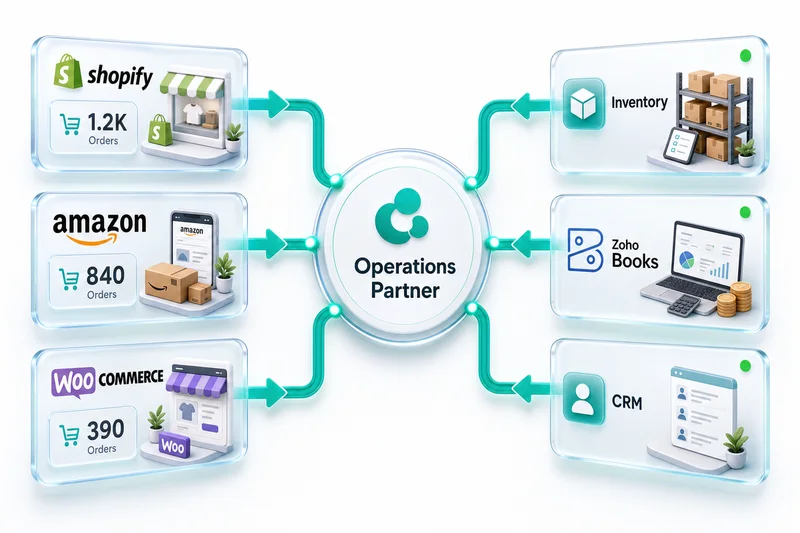
The problems AI targets in eCommerce are consistent across sellers and platforms. A Shopify seller running 600 SKUs manually checks sales velocity each week to decide what to reorder, then stockouts anyway because the check is weekly and demand moves faster. An Amazon seller spends 90 minutes every settlement period sorting a 3,000-row CSV to understand what marketplace fees came out of the payout. A multi-channel operator pulls three separate reports from Shopify, Amazon, and WooCommerce, copies them into a spreadsheet, and still cannot get a clean view of gross margin by channel.
These are pattern-recognition problems at scale. AI handles pattern recognition faster and at lower cost than manual review. That is the foundation of every AI feature in Zoho's eCommerce-relevant products.
| Operations Problem | Manual Approach | AI-Powered Approach in Zoho |
|---|---|---|
| Reorder planning | Weekly velocity check per SKU | Demand forecasting with suggested quantities (Zoho Inventory) |
| Settlement reconciliation | Manual CSV review, manual fee mapping | Anomaly detection flags outliers; categorization suggestions (Zoho Books) |
| Multi-channel reporting | Spreadsheet assembly from multiple platforms | Natural language queries across connected data (Zoho Analytics) |
| Support ticket routing | Manual triage based on subject line | Sentiment analysis routes high-urgency tickets first (Zoho Desk) |
| B2B lead prioritization | Sales rep judgment | Predictive lead scoring from behavioral signals (Zoho CRM) |
Zoho Inventory: Demand Forecasting That Reduces Stockouts
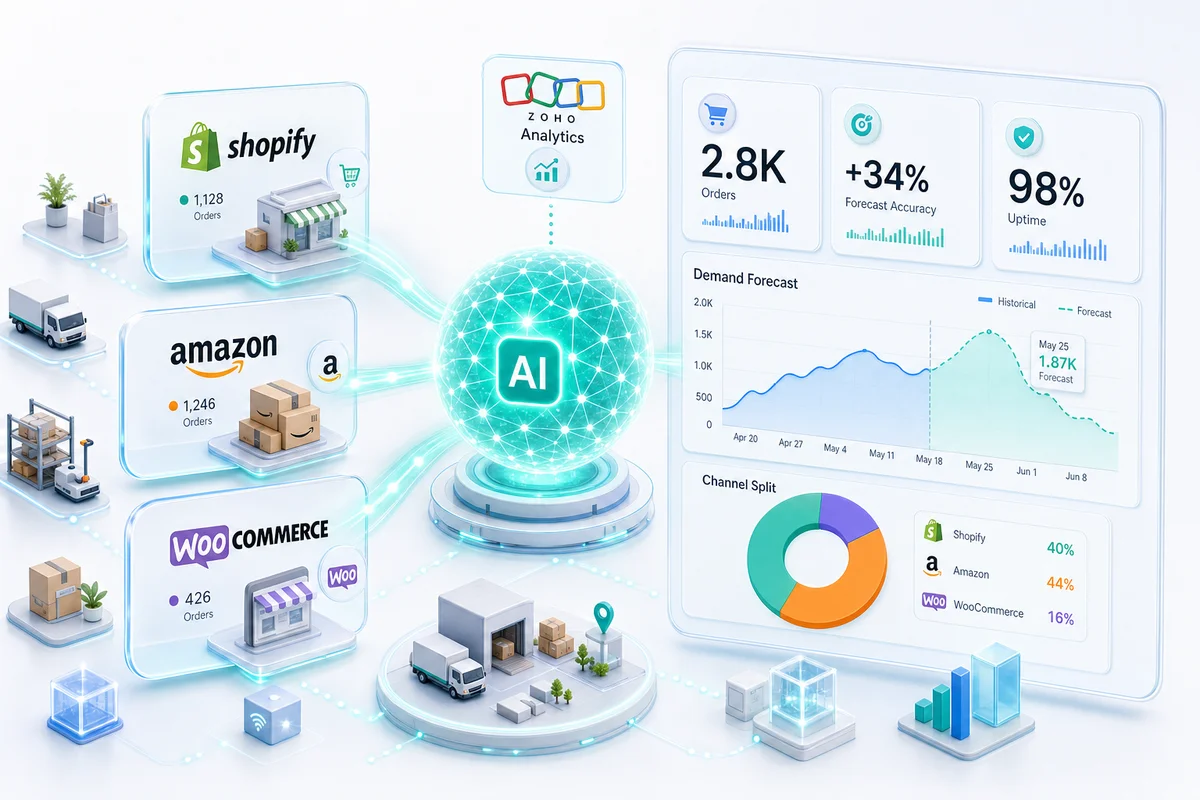
Zoho Inventory's demand forecasting analyzes historical sales data to predict future demand per SKU and generates reorder suggestions with recommended order quantities. For a seller managing inventory across Shopify and Amazon simultaneously, this matters because stockout risk differs by channel. An Amazon stockout suppresses a listing's ranking in ways a Shopify stockout does not, and recovering that ranking takes longer than restocking the SKU.
The forecasting model requires sufficient sales history to produce reliable outputs. Accuracy improves after a full seasonal cycle of clean transaction data. Sellers who have recently migrated from another inventory system should treat early suggestions as directional rather than prescriptive. New SKUs without sales history require manual velocity estimation until the model has enough signal. For established SKUs with 12 or more months of clean data, the forecasting substantially reduces the time buyers spend on manual reorder review each week.
Multi-warehouse operations benefit further because the forecasting model can factor in lead times and safety stock thresholds per location. A seller splitting inventory between a domestic warehouse and an Amazon FBA facility can set reorder points that account for the different replenishment timelines each fulfillment path requires.
For operators who want to configure the underlying demand forecasting inputs — velocity baselines, seasonal buffers, and reorder formulas — see the eCommerce demand forecasting setup guide for Zoho Inventory.
For a deeper look at how Zoho Inventory connects to Shopify's order and inventory data, see the Zoho Inventory for Shopify setup guide.
Zoho Books: Anomaly Detection and Bank Feed Assistance
Zoho Books uses AI to surface anomalies in financial data before they compound. Duplicate transactions, unusual amounts in recurring expense categories, and sudden changes in fee patterns appear in flagged alerts rather than buried in a month-end reconciliation. The system also learns from historical bank feed categorizations and suggests matches for new transactions based on patterns in prior entries.
For eCommerce sellers handling high transaction volumes across Shopify, Amazon, eBay, and Etsy, this reduces routine categorization time and surfaces exceptions that need human review. An Amazon seller processing 800 orders per settlement period has thousands of line items flowing through Zoho Books each month. AI-assisted flagging catches the outliers that would otherwise get missed until the quarterly close: the unusual fee amounts, the reimbursements that don't match expected values, the duplicate settlement entries.
What Zoho Books AI cannot do is make the underlying accounting decisions. How marketplace fee types map to your chart of accounts, how Amazon facilitator-collected tax should be recorded without inflating revenue, how clearing accounts should be structured for Shopify payouts: all of that requires a CA's judgment at setup. AI accelerates the ongoing categorization work after the structure is correct.
For the full mechanics of eCommerce bank reconciliation in Zoho Books, see Zoho Books Bank Reconciliation for eCommerce.
Zoho Analytics: Natural Language Queries for Multi-Channel Reporting
Zoho Analytics includes Zia-powered natural language querying. Sellers type questions in plain English and receive chart responses: "what was gross margin by channel in Q2," "which product categories had the highest return rate on WooCommerce last month," "show me Amazon vs Shopify revenue comparison for the past 12 weeks." The system generates visualizations from the underlying data without requiring the seller to build custom reports or write calculated fields.
For multi-channel operators, this removes a real barrier. The data needed to understand channel-level performance exists in Zoho, but extracting it historically required someone with BI skills to structure the queries correctly. Natural language querying makes the reporting layer accessible to the business owner, not just the analyst.
The quality of the answers is entirely dependent on data structure. Zoho Analytics can only return accurate gross margin figures if the sales revenue, cost of goods, and fee categorizations are correctly separated in the source data. Sellers whose Zoho setup books marketplace net deposits as single revenue entries will get analytics that answer questions quickly but answer them incorrectly.
See how Zoho Analytics for eCommerce reporting can be configured to produce accurate multi-channel dashboards from day one. For a fully managed setup, see Zolify's eCommerce Analytics & Reporting service.
Zoho Desk: AI-Assisted Support for High-Volume eCommerce Operations
eCommerce customer support scales with order volume. A seller processing 400 orders per day on Shopify and Amazon generates a proportional volume of post-purchase inquiries: shipping delays, return requests, product questions, account issues. Zoho Desk's AI capabilities address the triage and routing problems that emerge at that scale.
Zia in Zoho Desk performs sentiment analysis on incoming tickets, classifying messages by urgency and emotional tone. High-frustration tickets describing damaged goods, incorrect shipments, or repeated failures get routed to senior agents ahead of lower-priority inquiries. The system also suggests response templates based on ticket content, reducing the time agents spend drafting replies to common post-purchase queries.
For eCommerce operations where support quality directly affects marketplace seller ratings, faster triage is an operations metric, not just a customer experience concern. A delayed response to a negative post-purchase experience on Amazon influences both the customer's review and their likelihood of returning.
Connecting Zoho Desk to Zoho CRM lets support agents see a customer's full purchase history during a ticket interaction: order frequency, average order value, product categories purchased, channel of origin. This context reduces time spent gathering background and allows responses that reference the customer's actual history rather than treating every ticket as a new interaction.
Zoho CRM: Predictive Features for B2B eCommerce and Customer Retention
Zoho CRM's Zia features most relevant to eCommerce sellers include predictive lead scoring, email sentiment analysis, and best-time-to-contact recommendations. For B2B or wholesale eCommerce sellers managing trade accounts through CRM, predictive scoring surfaces the leads most likely to convert based on behavior patterns. For DTC sellers using CRM to manage customer retention, Zia can flag customers with declining purchase frequency early enough to trigger a re-engagement sequence before they stop buying entirely.
Email sentiment analysis classifies inbound customer emails by urgency and tone, allowing support queues to route high-frustration or high-value tickets to the right team member first. For eCommerce operations where post-purchase support volume scales with order volume, this reduces the manual triage work that otherwise delays response to critical issues.
Best-time-to-contact recommendations use engagement data - email open times, website visit patterns, prior call outcomes - to suggest optimal outreach windows per contact. For wholesale eCommerce accounts managed by a sales team, this reduces the calls that go to voicemail and the emails that sit unread.
The Data Quality Problem: Why AI Features Underdeliver Without the Right Setup
The most common reason AI features in Zoho produce disappointing results for eCommerce sellers is not a product limitation. It is data quality. Demand forecasting reads from inventory transaction history: if that history contains duplicate entries, incomplete cost records, or unmapped SKU variants, the forecasts reflect noise rather than signal. Analytics natural language queries return figures that are only as accurate as the underlying categorizations in Zoho Books. Anomaly detection flags based on a baseline derived from your historical data: if that baseline was built from miscategorized transactions during the setup period, the alerts fire at the wrong thresholds.
This pattern repeats across eCommerce implementations. Sellers who migrated from spreadsheets or a legacy accounting tool carry forward data structured for a different system. Sellers who set up Zoho themselves often book marketplace payouts as lump sums rather than separating gross sales, fees, and adjustments, which produces accounting figures usable for tax purposes but unsuitable as inputs for AI-driven margin analytics.
The fix is not a software upgrade. It is a correctly structured implementation from the start: a chart of accounts designed for multi-channel eCommerce, fee mapping reviewed by a CA, inventory records with accurate cost layers, and data migration that restructures legacy records into Zoho's expected format before AI features are enabled.
What AI Still Cannot Do in eCommerce Operations
The AI features in Zoho handle pattern recognition, anomaly flagging, and demand projection. They do not handle decisions that require accounting domain knowledge or eCommerce-specific implementation judgment.
Setting up a chart of accounts for a seller running Shopify, Amazon, and an Etsy storefront requires understanding how each platform's fee structure maps to accounting categories, and that structure differs by marketplace. Configuring marketplace fee reconciliation to produce accurate channel-level gross margins requires someone who has done it before across multiple platforms. Deciding how to handle sales tax across US states with economic nexus, or GST for Australian Shopify sales, is not a task Zia resolves.
For sellers with high-volume Amazon operations, the AI-assisted settlement parsing still needs a human to validate that the chart of accounts underneath is correctly structured. The AI can categorize transactions faster once the categories are defined correctly. It cannot define the categories.
Before You Enable AI Features: An Operations Readiness Checklist
Getting value from Zoho's AI capabilities requires the underlying stack to be ready. Before relying on demand forecasts, analytics queries, or anomaly alerts as operational inputs, verify these conditions are met.
Zoho Inventory:
- All SKUs have accurate cost records at the correct cost basis
- Fulfillment channels (Shopify, Amazon, WooCommerce) are mapped as distinct warehouses or location types
- At least 6 months of clean inventory transaction history exists in Zoho (12 months preferred for seasonal SKUs)
- Reorder point and safety stock settings reflect your actual lead times per supplier and channel
Zoho Books:
- Chart of accounts separates revenue by channel (Shopify Sales, Amazon Sales, WooCommerce Sales as distinct accounts)
- Marketplace fees have dedicated expense accounts per fee type, not a single catch-all category
- Clearing accounts are in place for each marketplace payout to handle timing differences between orders and settlements
- Bank reconciliation is current (anomaly detection works from a clean baseline)
Zoho Analytics:
- Data connectors for Zoho Books, Zoho Inventory, and Zoho CRM are active and syncing on the correct schedule
- Joins between data sources have been configured and validated
- At least one full reporting period of connected data exists before relying on multi-source queries
The Zolify Approach: Configure the Stack First, Then Let AI Work
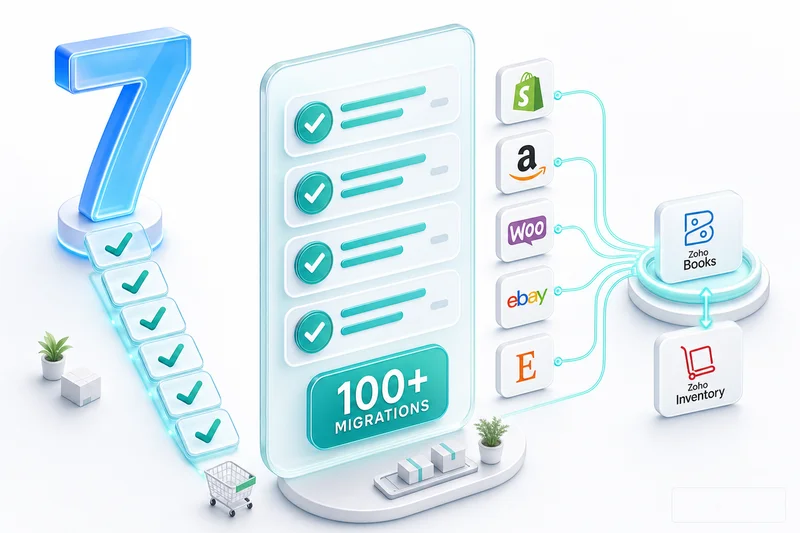
Zolify has completed 100+ eCommerce implementations across Shopify, Amazon, WooCommerce, eBay, and Etsy storefronts connected to Zoho. The pattern across those projects is consistent: AI features in Zoho produce their value after the stack is correctly configured, not before. Sellers who deployed Zoho quickly without expert setup find that demand forecasts read from incomplete inventory data, analytics queries return figures that don't match their actual margins, and anomaly detection flags the wrong things because the normal baseline was never defined correctly.
Our CA on staff handles the financial layer at setup: chart of accounts design, marketplace fee mapping, clearing account structure, and bank reconciliation configuration. Our integration team handles the data layer: connecting each storefront's order, inventory, and financial data to Zoho in the right structure, with correct field mapping and error handling built in. As an Official Zoho Authorized Partner, we implement across the full Zoho suite (Inventory, Books, CRM, Analytics, and Desk) so the AI features in each product read from the same clean, correctly structured source.
The sellers getting real value from Zoho's AI capabilities in 2026 are not the ones who deployed the fastest. They are the ones whose implementations were structured correctly from the start.
Getting the Setup Right
If you are running eCommerce on Shopify, Amazon, or WooCommerce and want to understand what AI-powered operations would look like for your specific volume and channel mix, the starting point is an eCommerce Ops Audit. We review your current operations stack, identify where automation would close the gaps, and specify the Zoho configuration that gets you there. No commitment, clear scope, CA and integration expertise on the call.
For a broader view of the Zoho products involved in a full eCommerce operations stack, see Zoho for eCommerce: The Complete Operations Platform Guide. For implementation scope, pricing, and next steps, see Zolify's eCommerce Operations service.
Frequently Asked Questions
Zoho's AI assistant Zia is embedded across several products relevant to eCommerce: Zoho Inventory uses AI-powered demand forecasting to suggest reorder quantities based on sales velocity; Zoho Books surfaces anomalies in financial data and assists with bank feed categorization; Zoho Analytics (powered by Zia) lets sellers ask plain-language questions about sales and inventory data; and Zoho CRM uses predictive scoring to prioritize high-value B2B eCommerce leads. These are features embedded in the operational tools eCommerce sellers already use, not standalone AI products that require separate configuration.
No. AI in Zoho Books accelerates bookkeeping by suggesting bank feed categorizations and flagging anomalies, but it cannot handle accounting decisions that require domain judgment: how to classify marketplace fees by type, how to structure a chart of accounts for a Shopify-plus-Amazon operation, or how to apply sales tax rules across multiple jurisdictions. A CA or CPA still needs to configure the system, review edge cases, and validate the financial output. AI reduces the manual work. It does not replace the expertise that makes the output correct.
Yes. Zoho Inventory includes demand forecasting that analyzes historical sales data to predict future demand per SKU and generate reorder suggestions with recommended quantities. For sellers managing stock across Shopify, Amazon, and WooCommerce simultaneously, this reduces stockout risk without requiring manual velocity review per SKU. The model becomes more accurate after a full seasonal cycle of clean data. New sellers or recently migrated operations should validate early suggestions manually until the model has 6 to 12 months of reliable history.
Zoho Analytics includes Zia-powered natural language queries. Sellers can ask questions like 'what was my gross margin on Amazon last quarter' or 'which WooCommerce products had the highest return rate in June' and receive chart responses without writing formulas or building custom reports. For multi-channel sellers, this removes the BI skills barrier for extracting actionable data from complex, cross-platform datasets. The quality of the answers depends entirely on how cleanly the underlying sales, fee, and inventory data is structured in Zoho.
Three things: a correctly structured Zoho product stack configured for your specific channels and order volumes (Inventory, Books, CRM, and Analytics working together), clean historical data so AI models have accurate inputs to learn from, and a clear definition of what you want automation to handle: demand forecasting, anomaly detection, report generation, or lead scoring. Without clean data and a properly configured backend, AI features in Zoho produce unreliable outputs. Implementation quality is the single largest factor in whether any of it delivers real results.
See exactly where your Shopify, Amazon, or WooCommerce ops are leaking — free.
Get a personalised eCommerce Ops Audit: inventory gaps, accounting leaks, and order-flow bottlenecks — with a Zoho fix roadmap. Delivered in 48 hours, at no cost.