FIFO vs Weighted Average: Inventory Valuation for eCommerce Sellers in Zoho Books
The inventory valuation method you configure in Zoho Books determines whether your COGS numbers are meaningful or misleading. This guide explains FIFO vs weighted average cost for Shopify, Amazon, and WooCommerce sellers, shows what each method does to gross margin with real examples, and walks through the exact setup steps in Zoho Books.
# FIFO vs Weighted Average: Inventory Valuation for eCommerce Sellers in Zoho Books
For Shopify, Amazon, and WooCommerce sellers approaching year-end, the inventory valuation method configured in Zoho Books determines whether the COGS line on the P&L is trustworthy or a rough approximation. FIFO (first in, first out) and weighted average cost produce materially different gross margin numbers for the same physical inventory — and choosing the wrong method for your product profile creates a COGS figure that does not reflect what you actually paid for the goods you sold.
Why Inventory Valuation Method Matters for eCommerce Sellers
The inventory valuation method determines how Zoho Books assigns a cost to each unit sold when you hold goods purchased at different prices over time.
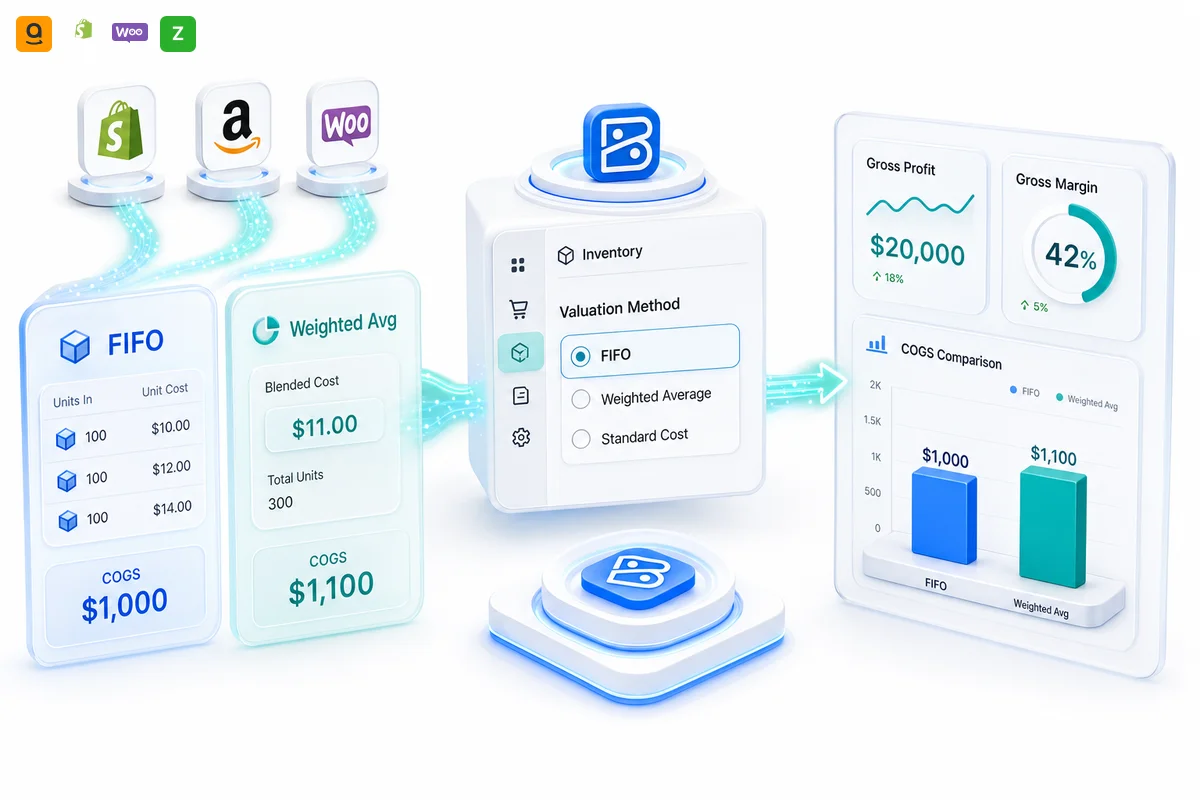
Consider a seller who bought 100 units of a product at $10 in March and another 100 units at $12 in July, then sold 100 units in November. Under FIFO, those 100 sold units are assumed to come from the March batch: COGS equals $1,000, and the $1,200 July batch stays in inventory. Under weighted average cost, all 200 units are pooled at an average of $11 each: COGS equals $1,100, with the remaining 100 units carrying the same $11 average.
That $100 difference in COGS flows directly to gross profit. Same revenue, same physical shipment, two different margin figures. At scale, a seller moving 10,000 units across 200 SKUs with quarterly price fluctuations sees these differences compound into materially different P&L and balance sheet presentations.
Inventory valuation also affects taxable income. The method you select is an accounting policy: it must be applied consistently, disclosed in financial statements, and changing it mid-year is treated as an accounting policy change with potential tax consequences. The right time to make this decision is before the first purchase order enters Zoho Books, not after a year of transactions has already been recorded under the wrong method. Sellers running a mid-year inventory count at June 30 should confirm the valuation method is unchanged before submitting count results — a method switch at that point carries the same accounting policy implications as a year-end switch.
FIFO vs Weighted Average: What Each Method Does
How FIFO Works (Shopify Seller Example)
FIFO assumes the oldest goods in inventory are sold first. Each time Zoho Books records a sale, it assigns the cost of the earliest unsold purchase batch to that transaction.
A Shopify seller carries a fashion accessory purchased across three batches:
| Batch | Date | Units | Unit Cost | Total Cost |
|---|---|---|---|---|
| 1 | February | 200 | $8.00 | $1,600 |
| 2 | June | 200 | $9.50 | $1,900 |
| 3 | September | 200 | $11.00 | $2,200 |
She sells 350 units in October. Under FIFO, Zoho Books calculates COGS as: 200 units at $8.00 plus 150 units at $9.50 = $3,025. The remaining 250 units (50 from the June batch, 200 from the September batch) carry costs of $9.50 and $11.00 respectively on the balance sheet.
FIFO produces a COGS number that follows actual purchase history in sequence. For sellers where purchase prices are rising — common for imported goods — FIFO expenses older, cheaper inventory first, resulting in lower COGS and higher reported gross margin compared to weighted average in the same period.
How Weighted Average Cost Works (Amazon Seller Example)
Weighted average cost pools all units in inventory into a single per-unit average, updated with each new purchase receipt. Every sale draws from that average regardless of when specific batches were purchased.
An Amazon FBA seller carries a consumer electronics accessory:
- Existing stock: 500 units at $15.00 average cost ($7,500 total inventory value)
- New purchase receipt: 500 units at $17.00 each ($8,500)
- New weighted average: ($7,500 + $8,500) divided by 1,000 units = $16.00 per unit
Every unit sold after this receipt records COGS at $16.00, whether it was picked from the earlier batch or the newer one. This produces a smoother COGS line over time, less sensitive to individual purchase price spikes. High-volume sellers also avoid the reconciliation overhead of tracking batch-by-batch FIFO layers.
Side-by-Side: FIFO vs Weighted Average at a Glance
| FIFO | Weighted Average | |
|---|---|---|
| COGS basis | Oldest purchase batch first | Pooled average of all units |
| When prices rise | Lower COGS, higher gross margin | COGS tracks closer to current prices |
| When prices fall | Higher COGS, lower gross margin | COGS tracks closer to current prices |
| Inventory on balance sheet | Reflects most recent purchase batches | Reflects pooled average |
| Best for | Price-volatile goods, fashion, seasonals | High-volume, commodity SKUs, stable pricing |
| Reconciliation complexity | Higher — batch layers tracked per SKU | Lower — single average per SKU |
Which Inventory Valuation Method Is Right for Your eCommerce Business?
When FIFO Makes Sense
FIFO produces more accurate COGS when purchase prices fluctuate meaningfully across orders: seasonal goods, fashion, electronics, agricultural imports. If products have expiry dates or must be physically rotated in order, the accounting method mirrors warehouse reality — which simplifies year-end COGS audits because each batch traces from purchase to sale. FIFO is also the right choice when auditable cost layers matter for financial reporting or investor review, or when price volatility across buying seasons exceeds 15%.
Shopify sellers in fashion, apparel, and seasonal goods almost always land here. A spring buy versus a holiday buy on the same SKU can differ by 20% or more.
When Weighted Average Makes Sense
Weighted average makes sense when products are commodity-grade with stable, predictable pricing: phone accessories, standard hardware, consumables. It also works better when transaction volume is very high and FIFO batch tracking would generate reconciliation overhead without proportionate accuracy benefit, or when the same SKU is purchased from multiple suppliers at slightly different prices and tracking per-batch is operationally impractical.
Amazon sellers in high-volume commodity categories, where the same SKU sells at the same price all year and purchase price variance is narrow, generally find weighted average produces an equivalent result with significantly less overhead.
Platform Considerations: Shopify, Amazon, WooCommerce
Shopify: Shopify sellers typically have well-defined purchase orders and supplier relationships where FIFO's batch tracking is practical. The Shopify inventory model maps naturally to FIFO layers in Zoho Inventory. If Shopify product costs are used for reference (not as the accounting source), FIFO COGS in Zoho Books will usually be more accurate than Shopify's own margin reporting, which relies on the cost field in each product record.
Amazon FBA: Amazon commingles FBA inventory in fulfillment centers. Amazon does not guarantee that the oldest physical unit ships first. For accounting purposes, FIFO can still be applied in Zoho Books even when physical FIFO is not guaranteed in the warehouse, but the practical case for weighted average is stronger for high-volume FBA sellers where individual batch distinctions carry less accounting meaning. For FBA sellers, the landed cost of each inbound shipment — manufacturer POs, freight carrier bills, prep service fees, and Amazon inbound placement fees — is the starting inventory value that COGS draws from. The eCommerce purchase order management guide for Zoho Books covers how to structure POs for each FBA vendor type so landed cost feeds the correct inventory value before any valuation method is applied. For a complete walkthrough of how to record and allocate freight, customs duty, and insurance charges in Zoho Inventory and Zoho Books, see the landed cost accounting guide for eCommerce importers. Once those FBA POs convert to supplier bills on goods receipt, the eCommerce AP automation guide for Zoho Books covers the 3-way matching, multi-approver bill workflows, and batch payment release that handle the full supplier payment cycle without manual intervention. For FBA sellers managing seasonal demand spikes, accurate inventory valuation at both the pre-event inbound quantity stage and the post-event overstock clearance stage depends on the COGS calculation being current. The Amazon Prime Day inventory planning guide for Zoho Inventory covers how to size FBA inbound shipments to cover Prime Day demand without triggering IPI penalties from post-event excess inventory.
WooCommerce: WooCommerce sellers operating across self-fulfillment, drop-shipping, and third-party 3PL often find weighted average cleaner because drop-shipped inventory never touches a physical warehouse. Costs come directly from supplier invoices mapped to sales orders, with no physical batch to track.
How to Set Your Inventory Valuation Method in Zoho Books
Step 1 — Choose Before You Enter Transactions
The most important constraint in Zoho Books: the inventory valuation method must be selected before any inventory transactions are entered. Zoho does not recalculate historical COGS retroactively. If you are setting up a new Zoho Books organization, configure the valuation method as one of the first steps after creating the org. If the organization already has transactions, see the FAQ above on switching methods.
Step 2 — Configure in Zoho Books Organisation Settings
Navigate to Settings → Organisation Profile → Preferences. Under the Inventory section, you will find the valuation method selector with two options: FIFO and Average Cost (Zoho's label for weighted average cost — they are the same thing in Zoho Books). Select the method that fits your product profile and save. This setting applies organization-wide; individual items cannot use different methods within the same organization. Sellers implementing Zoho Finance Plus — where Zoho Inventory is bundled with Zoho Books at one price — configure this setting during the discovery sprint, before any inventory transactions are entered, as part of a CA-reviewed chart of accounts setup.
While configuring Organization Settings, verify that your eCommerce chart of accounts for Zoho Books is correctly structured. The COGS account and the inventory asset account referenced in the valuation setup both need to exist before tracked items can be created.
Step 3 — Verify Your COGS Is Calculating Correctly
After configuring the valuation method and entering at least two purchase receipts for the same item at different prices, create a test sales order and fulfill it. Then run the Profit and Loss report in Zoho Books and confirm the COGS line reflects the expected calculation. If COGS does not appear on the P&L, the item is not tracked in Zoho Inventory. The most common setup error behind missing COGS is covered in detail in the eCommerce COGS tracking guide for Zoho Books.
Step 4 — Run the Inventory Valuation Report in Zoho Books
Navigate to Reports → Inventory Summary → Inventory Valuation Summary. This report shows every tracked item, quantity on hand, average or FIFO layer cost, and total inventory value at the report date. Run it monthly to catch items with zero cost (purchase receipts missing unit price), negative quantity on hand (sync errors where recorded sales exceeded stock), or cost outliers (a single purchase receipt entered with the wrong unit price).
For year-end close, this report is the starting point for finalizing COGS before locking the accounting period.
Zoho's official inventory valuation documentation covers additional detail on the Inventory Valuation Summary report structure and how FIFO layers are displayed.
Year-End Close Implications for Your Valuation Method
The inventory valuation method you selected carries specific consequences at year-end close. Under FIFO, the inventory balance sheet value reflects the most recent purchase batches (older batches have been expensed as COGS). Under weighted average, it reflects the pooled average, which smooths both old and new purchase prices into a single figure.
Two risks appear specifically at year-end:
Switching methods mid-year is an accounting policy change. If you decide FIFO was wrong after nine months of transactions, changing to weighted average in Zoho Books requires rebuilding inventory from the start of the year. COGS figures for all prior months change, taxable income changes, and if estimated taxes were paid based on the original method, adjustments may follow. This is not a settings update. It is an accounting restatement.
Valuation method affects inventory write-downs. If goods become obsolete or lose market value, the write-down calculation under FIFO (based on specific batch costs) differs from weighted average (based on pooled average costs). Sellers carrying slow-moving inventory at year-end see different balance sheet values for the same physical goods depending on which method is active.
Review your valuation method with a CA before locking December's period if either situation applies. Once the method is confirmed, the next step is the count itself — run your year-end physical count in Zoho Inventory before December 31. Zolify's inventory and warehouse management service handles the full Zoho Inventory configuration for multi-channel sellers, including valuation method selection as part of the initial setup. For sellers managing Q4 reorder point decisions and COGS accuracy at the same time, the Q4 eCommerce operations guide for Zoho covers how to update inventory configuration during live peak season without disrupting open orders or ongoing reconciliation.
When to Get a CA Involved in This Decision
Most Zoho Books setup guides treat the inventory valuation method as a configuration choice. It is an accounting policy decision with tax and financial reporting consequences that extend well beyond the settings screen.
Get a CA involved before selecting the method when any of the following apply:
- Purchase price variance exceeds 15% across orders in a single year
- Inventory on the balance sheet exceeds $100,000
- The business sells across jurisdictions where COGS treatment may affect income allocation
- You are migrating from QuickBooks or Xero and need historical cost data to carry over consistently
If the business is approaching financing, acquisition review, or formal audit, the valuation method needs to be defensible on paper — not something chosen by default during setup.
Zolify has completed more than 100 eCommerce implementations on Zoho Books, with a Chartered Accountant on staff who reviews inventory valuation method selection as part of every setup engagement. As an Official Zoho Finance Partner, Zolify configures the valuation method as a deliberate accounting decision tied to each client's product profile, purchase pattern, and tax position — not a default left over from the setup wizard.
If you are approaching December with a valuation method you are not confident about, start with an eCommerce Operations Audit to map your full operations stack — inventory configuration, channel integrations, and COGS setup — before the period closes. A CA-backed review before locking the period costs far less than a restatement after. Book a CA-Backed Inventory Accounting Review to confirm your valuation method, COGS accuracy, and year-end readiness.
For Shopify Plus merchants managing multi-location inventory across expansion stores, the Shopify Plus enterprise accounting guide for Zoho Books covers how multi-location FIFO cost layers interact with Shopify Markets payouts and multi-currency Zoho Books configurations. For subscription box operators carrying composite bundle inventory where COGS includes packaging and fulfillment components, the subscription box accounting guide for Zoho Books covers how composite item builds interact with inventory valuation and deferred revenue recognition.
Frequently Asked Questions
Can I switch from FIFO to weighted average in Zoho Books after I've already entered transactions?
Switching inventory valuation methods after transactions are recorded is not a settings toggle. It requires rebuilding inventory history from the start of the financial year, which changes COGS for every prior period, alters gross margin, and may affect taxable income if estimated taxes were paid under the original method. If you are considering a switch, do it before the next fiscal year opens and have a CA review the tax impact first.
Does Zoho Books default to FIFO or weighted average if I never configure it?
Zoho Books defaults to FIFO if the valuation method is never explicitly set. Sellers who completed setup without visiting Organisation Settings may be running on FIFO without realising it. Check the setting under Settings, then Organisation Profile, then Preferences, and verify it matches your intended method.
How does my inventory valuation method affect my COGS and gross profit in Zoho Books?
The method determines the unit cost assigned to each item sold when you hold inventory purchased at different prices. Under FIFO in a rising-cost environment, COGS is lower and gross margin is higher than under weighted average. Under weighted average, COGS and margin are smoothed across purchase price fluctuations. Same revenue and same physical shipment, different gross profit figures depending on which method is active.
Is weighted average cost the same as "average cost" in Zoho Books settings?
Yes. Zoho Books labels the setting "Average Cost" in Organisation Preferences, but it computes as a weighted average: total cost of all units in stock divided by total quantity on hand, recalculated each time a new purchase receipt is posted. If your setting shows "Average Cost," you are running weighted average inventory valuation.
Which inventory valuation method do most Shopify and Amazon sellers use?
Shopify sellers in fashion, apparel, and seasonal goods tend toward FIFO because purchase prices vary meaningfully across buying cycles and batch traceability helps with margin analysis. Amazon FBA sellers in high-volume commodity categories more commonly use weighted average because transaction volume is high, price variance is narrow, and the smoothed COGS line simplifies reconciliation. Neither is universally correct. The right choice depends on product profile, purchase pattern, and how much price volatility you carry across batches.
Frequently Asked Questions
Switching inventory valuation methods in Zoho Books after transactions are recorded is not a settings toggle. It requires rebuilding inventory history from the start of the financial year, which changes COGS for every prior period, alters gross margin, and may affect taxable income if estimated taxes were paid based on the original method. This is treated as an accounting policy change, not a configuration update. If you are considering a switch, do it before the next fiscal year opens and have a CA review the impact on your tax position first.
Zoho Books defaults to FIFO if the inventory valuation method is never explicitly configured. This means sellers who completed Zoho Books setup without visiting Organisation Settings may be running on FIFO without realising it. Check your current setting under Settings, then Organisation Profile, then Preferences, and verify the Inventory section matches the method that fits your product profile.
The valuation method determines the unit cost assigned to each item sold when you hold inventory purchased at different prices over time. Under FIFO, the oldest purchase batches are expensed first, so in a rising-cost environment COGS is lower and gross margin is higher than under weighted average. Under weighted average, all units are pooled at a running average cost, so COGS and margin are smoothed across purchase price fluctuations. The same physical shipment produces different gross profit figures depending on which method is active.
Yes. Zoho Books labels the setting 'Average Cost' in Organisation Preferences, but it computes as a weighted average: the total cost of all units in stock divided by the total quantity on hand, recalculated each time a new purchase receipt is posted. The terms are used interchangeably in Zoho Books help documentation. If your setting shows 'Average Cost,' you are running weighted average inventory valuation.
Shopify sellers in fashion, apparel, and seasonal categories tend to use FIFO because purchase prices vary meaningfully across buying cycles and batch traceability matters for margin analysis. Amazon FBA sellers in high-volume commodity categories more commonly use weighted average because transaction volume is high, purchase price variance is narrow, and the smoothed COGS line simplifies reconciliation. Neither method is universally correct. The right choice depends on your product profile, purchase pattern, and how much price volatility you carry across batches.
See exactly where your Shopify, Amazon, or WooCommerce ops are leaking — free.
Get a personalised eCommerce Ops Audit: inventory gaps, accounting leaks, and order-flow bottlenecks — with a Zoho fix roadmap. Delivered in 48 hours, at no cost.